---
title: GoldenEye 007 PC Port
# v0.5.0: status bumped from v0.4.0. Description kept short (Bing's 160 limit).
description: >-
A native PC port of GoldenEye 007 (Nintendo 64, 1997), built from
decompiled source with a software RSP. v0.5.0 for Windows, Linux and
Steam Deck.
# Freshness signals for jekyll-seo-tag (article:published_time / modified_time
# and the WebPage JSON-LD dates). Keep these equal to the last real content
# change of THIS page, not to the last release.
date: '2026-10-05'
modified_time: '2026-10-05'
locale: en_US
# The masthead is this page's title, so its first content h2 must NOT get the
# amber page-title look (double header). See the .flat-title rule in
# _includes/head-custom.html.
flat_title: true
---
A native PC port of _GoldenEye 007_ (Rare, 1997, Nintendo 64), compiled from
the [GoldenEye 007 decompilation](https://github.com/n64decomp/007): the
original N64 game running from reconstructed source, not the Xbox 360
remaster. The N64's graphics coprocessor (RSP) is emulated in software; every
other hardware surface (video, audio, input, timers, save storage) is shimmed
in a dedicated `port/` layer, following the architecture of the
[Perfect Dark PC port](https://github.com/fgsfdsfgs/perfect_dark), the same
Rare "Indy" engine family, one hardware generation apart.
[Status](#status) · [Download](#download) · [See it running](#see-it-running) · [Known issues](#known-issues) · [Documentation](#documentation)
## Status
### v0.5.0 (2026-10-05) — the campaign and split-screen both run end to end.
- **Single-player campaign complete.** All 20 missions plus the
ending-credits sequence, completable end to end at a steady 60 fps.
- **2–4 player split-screen multiplayer.** Supported on every multiplayer
map; playtested on Windows, Linux and Steam Deck.
- **One real options system.** A single menu, laid out like the Perfect
Dark port's — plain-English wording, real-unit sliders, a one-line
description per option — with the game's own **N64 control styles as a
per-seat preset**.
- **Emulator save files load directly.** Copy a 1964 / Project64 save into
`data/` and it is converted on first launch.
- **A scalable HUD overlay**, fullscreen and window-centring controls, and
antialiased overlay controls.
- **A fidelity round checked frame-by-frame against the N64 game** (fog,
aspect-ratio letterboxing, the Watch menu's own settings), with the
reference-frame gate re-based on both platforms (21 levels, 63 frames
each).
- The small stuff: a menu wording, units and help-text pass, and
standardised menu spelling.
What remains is a short list, under [Known issues](#known-issues).
**This is a pre-1.0 release, not a finished product.** v1.0 is the target
for a polished, feature-complete build; expect missing features and the
occasional breaking change until then. The [README's Roadmap
section](https://github.com/jkdansereau/goldeneye-pc-port#roadmap) is the
single tracker for what comes next.
Known issues
NTSC-U ROMs only in the release packages. PAL and JP ROMs convert, build and run from source, but release packages ship the US (NTSC-U) ROM. On the roadmap.
Changing the aspect ratio in a level can briefly glitch the gun/hand model (cosmetic, one-off). Change the ratio from the front-end PC Options, or accept it (D509).
No macOS or ARM builds yet. Today the release ships Windows, Linux and Steam Deck (keyboard, mouse and controller-button rebinding are all supported, defaults in the README's Controls section); macOS and ARM are on the roadmap.
Skip intro and All unlocked are experimental — leave them off for a normal playthrough. All unlocked has not written your save since v0.4.1, but saves made while it was on in builds before v0.4.1 can hold fake unlocks and are not repaired; back up data/ge007.eep if you used it on an older build (D442, D387).
The first frame of a level takes a little longer while its textures upload — a brief FPS-counter dip; nothing to fix (D475, D480).
In widescreen, far objects almost fully in fog can still show a faint distant building edge (4:3 matches the N64). Cosmetic (D503).
Release history
Warning: always use the latest release — earlier builds are kept in the release history for reference only; they lack the features and fixes of newer versions, so don't install an older release.
2026-10-05 — v0.5.0: what it adds is the Status list above. Release notes.
2026-09-28 — v0.4.0: native widescreen, a complete aim system for mouse and controller, in-game key rebinding, crosshair customization, rumble-pak haptics, a rebuilt options overlay, and a broad fidelity-fix pass. Release notes.
2026-09-20 — v0.3.0: the first release with the complete campaign playable end to end at 60 fps on Windows, Linux, and Steam Deck. Release notes.
2026-09-04 → 2026-09-16 — v0.1.0 – v0.2.2: the alpha and beta cycle — build chain, software RSP, first rendered frames, front end, and per-level stabilization across the campaign.
## Download
| Platform | Bundle | Notes |
|---|---|---|
| **Windows** (x86_64) | [win64.zip](https://github.com/jkdansereau/goldeneye-pc-port/releases) | Engine + runtime DLLs + the one-time asset tool. |
| **Linux** (x86_64) / **Steam Deck** | [linux tarball](https://github.com/jkdansereau/goldeneye-pc-port/releases) | SDL2 is bundled, so it runs as-is on any distro, and sideloads onto a Deck with nothing installed. |
| macOS / ARM Linux | — | Roadmap: not shipped yet. |
**Bring your own ROM.** Both bundles contain no ROM and no game assets: you
supply your own GoldenEye 007 N64 ROM (the
[Requirements table](https://github.com/jkdansereau/goldeneye-pc-port#requirements)
has the region filenames and SHA-1s). This release supports the NTSC-U (US)
ROM; PAL and JP are on the roadmap. Then: unpack, drop the ROM in `data/`,
and launch; the first run generates the derived assets automatically (no
Python or other tooling needed). The full steps are in the
[Quick start](https://github.com/jkdansereau/goldeneye-pc-port#quick-start);
the packages carry no ROM or game assets, and run only with a ROM you
already own. The binaries are not code-signed; each
release artifact carries a GitHub build-provenance attestation you can
verify with `gh attestation verify --repo
jkdansereau/goldeneye-pc-port`.
What the release actually installs is covered on [Security status](security.md);
how faithfully it tracks the N64 game, on [Fidelity status](fidelity.md).
## See it running
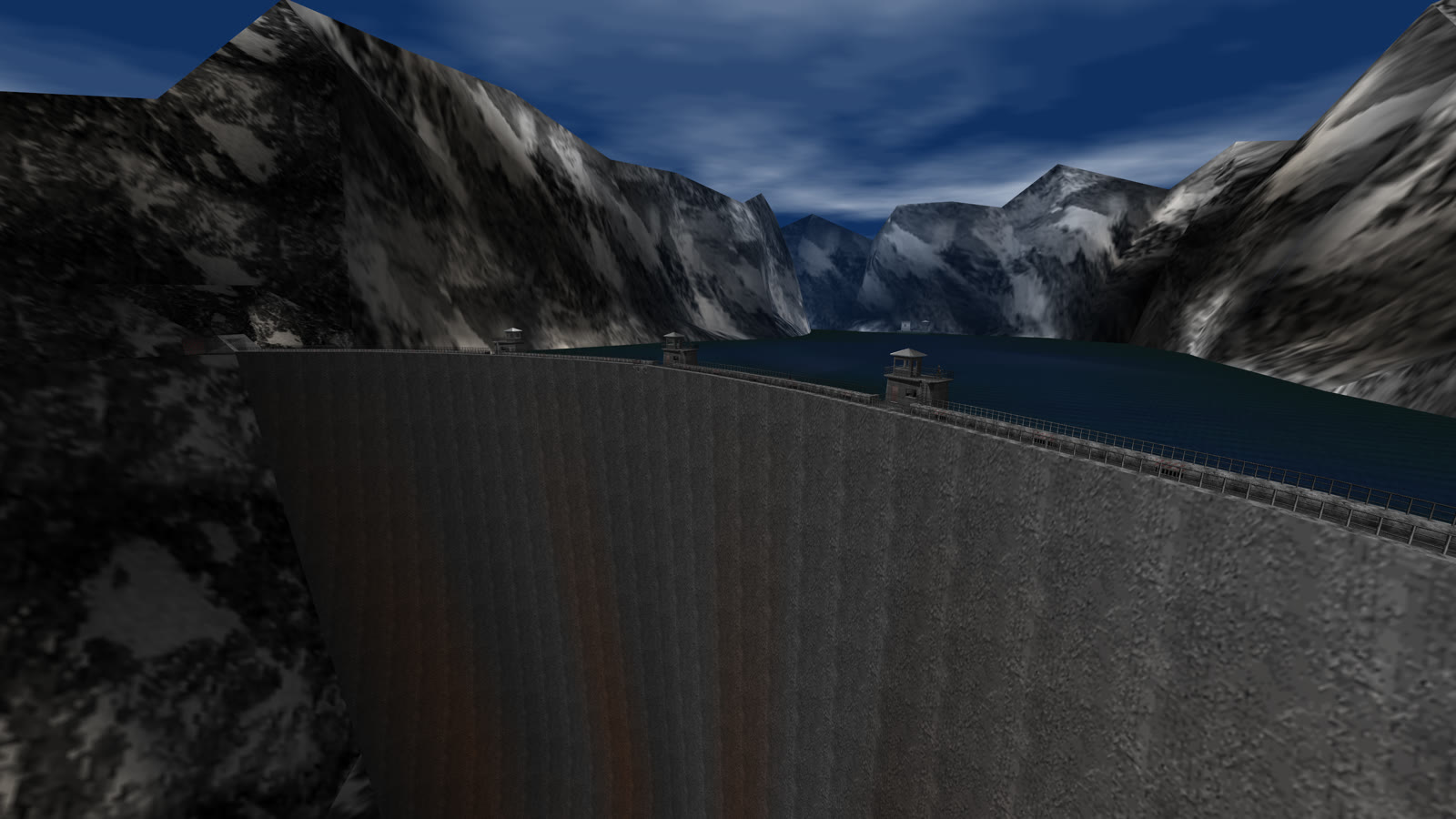
viewer — in-engine captures, 3072×17281 / 12
Dam — v0.4.0 intro attract
## Play it, or take it apart
- **Try it yourself**: grab a bundle above, bring your own ROM, and play the
campaign. It's a pre-1.0 build for exactly this: if something breaks, an
[issue](https://github.com/jkdansereau/goldeneye-pc-port/issues) with what
you were doing is genuinely useful.
- **Read the code**: the game logic in `src/` is unmodified decompilation;
every hardware surface (video, audio, input, save storage, and the
software-RSP renderer) is shimmed in the MIT-licensed `port/` layer.
[Internals](internals.md) is the map; [Porting notes](porting-notes.md) is
the catalogue of N64→PC bug classes hit along the way, a good read even if
you never touch the code.
- **Mod it**: the port layer, build system and `tools_pc/` helpers are MIT
licensed and yours to extend: new video options, input tweaks, your own
asset sidecar. [CONTRIBUTING](https://github.com/jkdansereau/goldeneye-pc-port/blob/main/CONTRIBUTING.md)
has the ground rules that keep it faithful to the original game.
- **AI disclosure**: development here used AI coding agents — Claude Code
plus a local open-weight model on a single RTX 5090, directed by one person
in their spare time. The project is as much a study of that process as it
is a port; the write-up records what happened and takes no position for or
against using LLMs on a project like this. See [the full
write-up](dev/agentic-development.md) — the setup, timeline, handoff
workflow, and an honest account of what did and didn't work.
## How it works
The R4300 game code's logic and control flow are the decompilation's, and
remain the reference we preserve. The port's changes inside `src/` are few in
kind and each is gated behind `#ifdef PORT`: mechanical 32→64-bit
pointer-width fixes, a couple of approved timing fixes, and the opt-in
*All unlocked* and *Skip intro* hooks. The N64's Reality Signal Processor
(RSP), the graphics coprocessor that builds and executes each frame's
display list, is emulated in software: the port interprets the graphics
command stream (GBI) the game emits and translates it to OpenGL, bypassing
the RDP entirely. Everything else that would touch N64 hardware (video,
audio, input, timers, save storage) is shimmed in a small dedicated layer,
following the architecture of the Perfect Dark PC port from the same Rare
engine family. Full detail: [Internals](internals.md); the bug
catalogue: [Porting notes](porting-notes.md).
## Documentation
The technical docs live on the [Documentation](documentation.md) page — the
architecture, the N64→PC bug catalogue, and how the project is developed.
[Building](building.md) covers building and running from source.